The goat problem problem.
Monty Hall? I don't see the problem
Prologue
It is known that the goat problem does not have a solution. However, this is not well known, at least judging by how often I still see people on the internet arguing about it. For example, these are some problems similar to the goat problem, let me know if you think they have a solution:
- A person gives you food; should you eat it?
- A person has in their home three containers, two of them contain healthy ingredients, one of them contains a mysterious chemical. The person hands you food; should you eat it?
- A person has 100 containers in their home, 99 contain healthy ingredients, one of them contains a mysterious chemical. You are about to open a random container and munch its contents when the person exclaims “Don’t eat that! It’s drugged!”. They open one of the other containers and eat what is inside while holding eye contact the entire time. They wink at you. Should you switch containers?
Act I: The Goat Problem
The Monty Hall problem (or “goat problem”[1]) is often phrased as follows – this for example is probably its most popular version also used on Wikipedia:
Suppose you’re on a game show, and you’re given the choice of three doors: Behind one door is a car; behind the others, goats. You pick a door, say No. 1, and the host, who knows what’s behind the doors, opens another door, say No. 3, which has a goat. He then says to you, “Do you want to pick door No. 2?” Is it to your advantage to switch your choice?
The canonical answer says that it is better to switch: The “unconditional”[2] chance that initially you picked the prize was 1/3. The show host can always open one of the other doors that does not contain a car, so that action of his doesn’t really add information: your initial door choice remains at a 1/3 probability of having the car (and the other 2/3 go to the other non-opened door). A lot of people get this intuition when they go through the “100 doors” thought experiment: The host presents you with the choice of 100 doors and, after you pick one, opens 98 doors[3] that he knows don’t contain the car. For most people here it becomes intuitive that it’s pretty unlikely that we picked the car initially, so it’s better to switch!
Act II: The Goat Problem Problem
Clearly, in that “canonical” version of the goat problem there is a missing piece of information: it’s the lack of information about the game show host’s behavior or intentions[4]. The problem does not work without making some kind of assumption about this, which means the original version does not contain the full required setup: the “goat problem” is not actually a problem. At least it’s not a statistical one, but more a problem of which implicit assumptions the reader begins to fill in, quite possibly subconsciously. That fill-in of unstated assumptions could perhaps be called “the Monty Hall problem problem”[5].
Again there are relatively straightforward thought experiments to see what happens under different host behaviors. For example, alternatively say
- they behave as the canonical answer implicitly assumes: Always show exactly one goat and offer to switch (if you chose a dud initially, open the one remaining door with a goat, and if you happened to choose a car-door initially, then open one of the two remaining goat-doors at random). Switching gives you the prize with probability 2/3.
- they only ever open a door and offer to switch if you initially picked the car (evil! 😈). In that case, definitely don’t take the offer – switching has a 0% chance of getting you the car!
- they only ever offer to switch if you initially picked a dud (in which case, definitely switch).
None of these possibilities are explicitly specified nor ruled out in the original formulation. In fact, there are an infinite number of other possible host behaviors[6] that can each land you at a different probability of winning when you switch. As a side note, also notice that the original version does not ask for the “probability” of where the car is — as that would require specifying more precisely which conditional probability they have in mind. (As a professor of mine used to say: “There is no unconditional probability”.) In any case, the Wikipedia article to the problem actually dedicates quite a bit more space to discussing just how important the implicit or explicit assumptions are than to discussing the main formulation or solution.

A (different) professor used to quip that the biggest insult a mathematician could hurl was to say that something was “not even wrong”[7]. Worse than failing at a proof is to not initially specify the problem in a way that lays out all the assumptions that can be used. The standard answer (“always switch!”) to the Monty Hall problem as quoted above is not even wrong. That’s the “Monty Hall problem problem”: The lack of assumptions about a key ingredient of the puzzle invites the reader to use their own, and then give an answer to a question that was not asked.
Act III: The Goat Problem Problem Problem
The buck[8] doesn’t stop there quite yet. We just identified the goat problem problem as an incomplete information/ambiguity issue. Therefore we might think that we can probably put this entire wretched game show to bed once and for all if only we neatly and comprehensively specify whatever assumptions/strategy/conditioning set we have in mind. Unfortunately[9], people don’t work like that. The wikipedia article describes that many readers sent their angry letters disagreeing with the canonical solution after the needed assumptions had been added to the problem for clarification. And lab experiments (as in Krauss and Wang, 2003) show that people fail to solve properly even when receiving the fully specified setup.
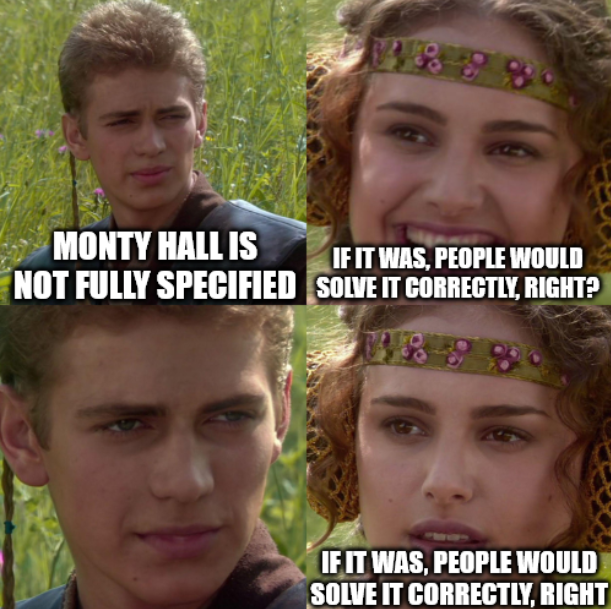
It turns out that people can still substitute in their own conditioning set even if that set was not empty before. They can make assumptions even if those are in conflict to other assumptions.
You might say, well, tough for them – they got it objectively wrong and I get to rub the “correct” solution in their faces. To which I say, you were the one who wanted them to think about goats, doors and cars in the first place, so it’s on you to make sure that they know what to do with it rather than burying the important stuff somewhere in the fine print.[10] Communication, as they say, is a two-way street, and it requires that the words you say mean the same to you as to the one who hears them. And this, friends, is the goat problem problem problem.
Epilogue
The person whose house you are at opens 98 food containers. You switch containers, grab out a cookie and take a bite. Immediately goats start appearing in front of you, and they dance in concentric circles around Monty Hall who is standing on a stage with one million computer-simulated doors. Monty laughs a friendly laugh and tells you to be explicit about what you’re conditioning your probabilities on. He mentions something about not telling people they are wrong when they may just be solving a different problem, but you don’t quite catch it because a large number of simulated doors have just swung open. You hear him say a last few words, before you snap back to reality. “Nothing is wrong. Everything is differences in information sets. There is no goat problem. You are the goat problem.”
I think that naming concepts after people or other proper nouns is usually (though not always) a bad idea. So obscuring! In German it’s das Ziegenproblem, “the goat problem”. In lack of a better alternative we’ll go with that – at least it tells you there’s a goat involved, which is more than “Monty Hall” does for anyone born after 1980. ↩︎
Those are scarequotes – more on that in a second… ↩︎
The goat goat goat [… x98] problem ↩︎
The second thing we learned in Game Theory: gotta define the action space, information set and utility function for each player to describe a well-specified game. (The first thing was, “Everything is a game.”) ↩︎
A nod to the “Sunk Cost Fallacy Fallacy (Fallacy?)”. Topic for another day/blog post? 😬 ↩︎
See the Wikipedia article and also Jeffrey Rosenthal, who has a few good ones (“Monty Fall”) ↩︎
Apparently he was borrowing from Pauli. ↩︎
goat ↩︎
Or perhaps, fortunately. ↩︎
You who haveth always fully read and understood all Terms and Conditions and Privacy Notices may throw the first stone. ↩︎